Product Description
OUR PRODUCTS LIST:
A and B series single/double/triple standard roller chain and no-standard roller chain
| DIN/ISO | ANSI | Pitch | Roller | Width | Pin | Pin | Lnner | Plate | Ultimate | Average | weight | |
| KIN/ISO | ANSL | between | diameter | length | plate | thick | tensile | tensile | per | |||
| Chain | Chain | inner plates | depth | -ness | strength | strength | meter | |||||
| No. | No. | P | d1 | b1 | d2 | L | Lc | h2 | T | Q | Q0 | q |
| max | min | max | max | max | max | max | min | |||||
| mm | mm | mm | mm | mm | mm | mm | mm | kN/LB | kN | kg/m | ||
| *03C | *15 | 4.7625 | 2.48 | 2.38 | 1.62 | 6.1 | 6.9 | 4.3 | 0.6 | 1.80/409 | 2 | 0.08 |
| *04C-1 | *25 | 6.35 | 3.3 | 3.18 | 2.31 | 7.9 | 8.4 | 6 | 0.8 | 3.50/795 | 4.6 | 0.15 |
| *06C-1 | *35 | 9.525 | 5.08 | 4.77 | 3.58 | 12.4 | 13.17 | 9 | 1.3 | 7.90/1795 | 10.8 | 0.33 |
| 085-1 | 41 | 12.7 | 7.77 | 6.25 | 3.58 | 13.75 | 15 | 9.91 | 1.3 | 6.67/1516 | 12.6 | 0.41 |
| 08A-1 | 40 | 12.7 | 7.95 | 7.85 | 3.96 | 16.6 | 17.8 | 12 | 1.5 | 14.10/3205 | 17.5 | 0.62 |
| 10A-1 | 50 | 15.875 | 10.16 | 9.4 | 5.08 | 20.7 | 22.2 | 15.09 | 2.03 | 22.20/5045 | 29.4 | 1.02 |
| 12A-1 | 60 | 19.05 | 11.91 | 12.57 | 5.94 | 25.9 | 27.7 | 18 | 2.42 | 31.80/7227 | 41.5 | 1.5 |
| 16A-1 | 80 | 25.4 | 15.88 | 15.75 | 7.92 | 32.7 | 35 | 24 | 3.25 | 59.70/12886 | 69.4 | 2.6 |
| 20A-1 | 100 | 31.75 | 19.05 | 18.9 | 9.53 | 40.4 | 44.7 | 30 | 4 | 88.50/20114 | 109.2 | 3.91 |
| 24A-1 | 120 | 38.1 | 22.23 | 25.22 | 11.1 | 50.3 | 54.3 | 35.7 | 4.8 | 127.00/28864 | 156.3 | 5.62 |
| 28A-1 | 140 | 44.45 | 25.4 | 25.22 | 12.7 | 54.4 | 59 | 41 | 5.6 | 172.40/39182 | 212 | 7.5 |
| 32A-1 | 160 | 50.8 | 28.58 | 31.55 | 14.27 | 64.8 | 69.6 | 47.8 | 6.4 | 226.80/51545 | 278.9 | 1.1 |
| 36A-1 | 180 | 57.15 | 35.71 | 35.48 | 17.46 | 72.8 | 78.6 | 53.6 | 7.2 | 280.20/63682 | 341.8 | 13.45 |
| 40A-1 | 200 | 63.5 | 39.68 | 37.85 | 19.85 | 80.3 | 87.2 | 60 | 8 | 353.80/80409 | 431.6 | 16.15 |
| 48A-1 | 240 | 76.2 | 47.63 | 47.35 | 23.81 | 90.5 | 103 | 72.39 | 9.5 | 51.30/115977 | 622.5 | 23.2 |
| DIN/ISO | Pitch | Roller | Width | Pin | Pin | Lnner | Plate | Ultimate | Average | weight | |
| KIN/ISO | between | diameter | length | plate | thick | tensile | tensile | per | |||
| Chain | inner plates | depth | -ness | strength | strength | meter | |||||
| No. | P | d1 | b1 | d2 | L | Lc | h2 | T | Q | Q0 | q |
| max | min | max | max | max | max | max | min | ||||
| mm | mm | mm | mm | mm | mm | mm | mm | kN/LB | kN | kg/m | |
| 04B-1 | 6 | 4 | 2.8 | 1.85 | 6.8 | 7.8 | 5 | 0.6 | 3.2/682 | 3.2 | 0.11 |
| 05B-1 | 8 | 5 | 3 | 2.31 | 8.2 | 8.9 | 7.1 | 0.8 | 5.0/1136 | 5.9 | 0.2 |
| *06B-1 | 9.525 | 6.35 | 5.72 | 3.28 | 13.15 | 14.1 | 8.2 | 1.3 | 9.0/2045 | 10.4 | 0.41 |
| 08B-1 | 12.7 | 8.51 | 7.75 | 4.45 | 16.7 | 18.2 | 11.8 | 1.6 | 18.0/4091 | 19.4 | 0.69 |
| 10B-1 | 15.875 | 10.16 | 9.65 | 5.08 | 19.5 | 20.9 | 14.7 | 1.7 | 22.4/5091 | 27.5 | 0.93 |
| 12B-1 | 19.05 | 12.07 | 11.68 | 5.72 | 22.5 | 24.2 | 16 | 1.85 | 29.0/6591 | 32.2 | 1.15 |
| 16B-1 | 25.4 | 15.88 | 17.02 | 8.28 | 36.1 | 37.4 | 21 | 4.15/3.1 | 60.0/13636 | 72.8 | 2.71 |
| 20B-1 | 31.75 | 19.05 | 19.56 | 10.19 | 41.3 | 45 | 26.4 | 4.5/3.5 | 95.0/21591 | 106.7 | 3.7 |
| 24B-1 | 38.1 | 25.4 | 25.4 | 14.63 | 53.4 | 57.8 | 33.2 | 6.0/4.8 | 160.0/36364 | 178 | 7.1 |
| 28B-1 | 44.45 | 27.94 | 30.99 | 15.9 | 65.1 | 69.5 | 36.7 | 7.5/6.0 | 200.0/45455 | 222 | 8.5 |
| 32B-1 | 50.8 | 29.21 | 30.99 | 17.81 | 66 | 71 | 42 | 7.0/6.0 | 250.0/56818 | 277.5 | 10.25 |
| 40B-1 | 63.5 | 39.37 | 38.1 | 22.89 | 82.2 | 89.2 | 52.96 | 8.5/8.0 | 355.0/80682 | 394 | 16.35 |
| 48B-1 | 76.2 | 48.26 | 45.72 | 29.24 | 99.1 | 107 | 63.8 | 560.0/127272 | 621.6 | 25 | |
Products show
Our workshop
Our hot treatment equipment
FAQ
Q1. What is your terms of packing?
A: Generally, we pack our goods in single color box. If you have special request about packing, pls negotiate with us in advance, we can pack the goods as your request.
Q2. What is your terms of payment?
A: T/T 30% as deposit, and 70% before delivery. We’ll show you the photos of the products and packages
before you pay the balance. Other payments terms, pls negotiate with us in advance, we can discuss.
Q3. What is your terms of delivery?
A: EXW, FOB, CFR, CIF.
Q4. How about your delivery time?
A: Generally, it will take 25 to 30 days after receiving your advance payment. The specific delivery time depends
on the items and the quantity of your order.
Q5. Can you produce according to the samples?
A: Yes, we can produce by your samples or technical drawings. We can build the molds and fixtures.
Q6. What is your sample policy?
A: We can supply the sample if we have ready parts in stock, but the customers have to pay the sample cost and
the courier cost.We welcome sample order.
Q7. Do you test all your goods before delivery?
A: Yes, we have 100% test before delivery
Q8: How do you make our business long-term and good relationship?
1. We keep good quality and competitive price to ensure our customers benefit ;
2. We respect every customer as our friend and we sincerely do business and make friends with them,
no matter where they come from.
| Material: | Alloy |
|---|---|
| Structure: | Roller Chain |
| Surface Treatment: | Polishing |
| Chain Size: | 1/2"*11/128" |
| Feature: | Fire Resistant, Oil Resistant, Heat Resistant |
| Transport Package: | Non-Fumigation Wooden Box, by Air, by Ocean |
| Samples: |
US$ 2/Meter
1 Meter(Min.Order) | |
|---|
| Customization: |
Available
| Customized Request |
|---|

How do you ensure proper tensioning and alignment of a conveyor chain?
Proper tensioning and alignment are essential for the efficient and reliable operation of a conveyor chain. Here are the steps to ensure correct tensioning and alignment:
1. Initial Installation:
- Ensure that the conveyor frame and supports are properly aligned and leveled before installing the chain. Any misalignment or unevenness can lead to tensioning and alignment issues.
- Follow the manufacturer's guidelines and specifications for chain installation. This includes proper placement of sprockets, tensioners, and guides.
2. Tensioning:
- Adjust the tension of the chain to the manufacturer's recommended specifications. Proper tension prevents excessive sagging or tightness, reducing wear and extending the chain's life.
- Use tensioning devices, such as adjustable take-up units or tensioning screws, to achieve the desired tension. Refer to the manufacturer's guidelines for the appropriate method of tensioning for your specific conveyor chain.
- Regularly check and adjust the tension as needed. Factors such as chain wear, load variations, and temperature changes can affect the chain's tension over time.
3. Alignment:
- Check the alignment of the chain with respect to the sprockets and guides. Misalignment can cause uneven wear, increased friction, and premature failure of the chain.
- Inspect the alignment by visually examining the chain's path along the sprockets and guides. It should run smoothly without any signs of rubbing or excessive deviation.
- Use alignment tools, such as laser alignment devices or straightedges, to accurately assess and correct any misalignment. Adjust the position of sprockets, guides, and supports as necessary.
4. Regular Maintenance:
- Implement a scheduled maintenance program to regularly inspect and maintain proper tensioning and alignment of the conveyor chain.
- Monitor the chain's performance, including wear patterns, noise levels, and power consumption, as indicators of potential tensioning or alignment issues.
- Keep the chain clean and free from debris or contaminants that can affect its movement and alignment.
By following these steps and regularly monitoring the tensioning and alignment of the conveyor chain, you can ensure smooth and reliable operation, minimize chain wear, and reduce the risk of unexpected failures.
Can a conveyor chain be used for heavy-duty applications?
Yes, a conveyor chain can be used for heavy-duty applications. Conveyor chains are specifically designed to handle heavy loads and provide reliable transportation in industrial environments.
Here are some factors that make conveyor chains suitable for heavy-duty applications:
1. Robust construction: Conveyor chains are typically made from high-strength materials such as alloy steel, stainless steel, or hardened carbon steel. These materials offer excellent durability and can withstand the heavy loads and harsh operating conditions commonly found in heavy-duty applications.
2. High load-carrying capacity: Conveyor chains are designed to handle significant loads, including heavy products, bulk materials, or large components. The chains are engineered with appropriate pitch, link dimensions, and strength to ensure reliable transport of heavy items.
3. Fatigue resistance: Conveyor chains are built to withstand repetitive stress and fatigue caused by continuous operation under heavy loads. They undergo specific heat treatments and surface hardening processes to enhance their resistance to wear, fatigue, and deformation.
4. Customization options: Conveyor chains can be customized to meet the specific requirements of heavy-duty applications. This includes selecting the appropriate chain type, pitch, attachment design, and surface coating for improved performance and longevity.
5. Compatibility with heavy-duty equipment: Conveyor chains are designed to integrate seamlessly with heavy-duty conveyor systems, including large motors, drives, and supporting structures. This ensures proper power transmission and smooth operation even in demanding environments.
6. Safety features: Conveyor chains for heavy-duty applications often incorporate safety features such as overload protection, emergency stops, and monitoring systems to ensure the safety of operators and prevent damage to the equipment.
It's important to consult with a qualified engineer or conveyor manufacturer to select the appropriate conveyor chain and system components for the specific heavy-duty application. They can provide guidance on chain selection, system design, and maintenance practices to ensure optimal performance and reliability.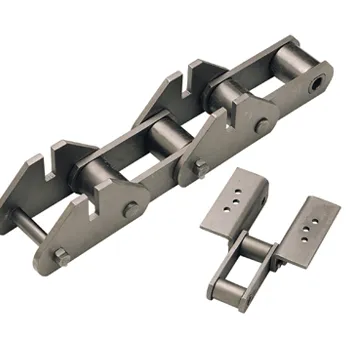
What are the maintenance requirements for a conveyor chain?
Maintaining a conveyor chain is essential to ensure its smooth operation and prolong its lifespan. Here are some key maintenance requirements for a conveyor chain:
- Regular Cleaning: Clean the conveyor chain regularly to remove dirt, debris, and contaminants that can contribute to chain wear and reduce performance. Use appropriate cleaning agents and tools to avoid damaging the chain.
- Lubrication: Apply the recommended lubricant to the conveyor chain according to the manufacturer’s guidelines. Lubrication helps reduce friction, minimize wear, and prevent corrosion.
- Tension Adjustment: Check the tension of the conveyor chain regularly and adjust it if necessary. Proper tension ensures smooth operation and prevents issues like chain slipping or excessive wear.
- Inspection: Conduct regular inspections of the conveyor chain to identify any signs of wear, damage, or misalignment. Look for issues such as worn sprockets, elongation, bent or damaged links, and loose connections. Address any problems promptly to prevent further damage.
- Replace Worn Components: If any components of the conveyor chain, such as links, pins, or sprockets, are excessively worn or damaged, they should be replaced. Using worn components can compromise the chain’s performance and lead to failure.
- Alignment: Ensure proper alignment of the conveyor chain by checking the alignment of sprockets, idlers, and other components. Misalignment can cause uneven wear and increase the risk of chain failure.
- Training and Education: Provide proper training to personnel responsible for operating and maintaining the conveyor chain. They should understand the maintenance requirements, safety protocols, and best practices to ensure effective and safe operation.
Following these maintenance requirements will help keep the conveyor chain in optimal condition, minimize downtime, and ensure safe and efficient material handling.

editor by CX 2023-07-18